The Singer’s Library: Wholehearted Voice Pedagogy

A new book explores a “wholehearted approach” to vocal pedagogy.
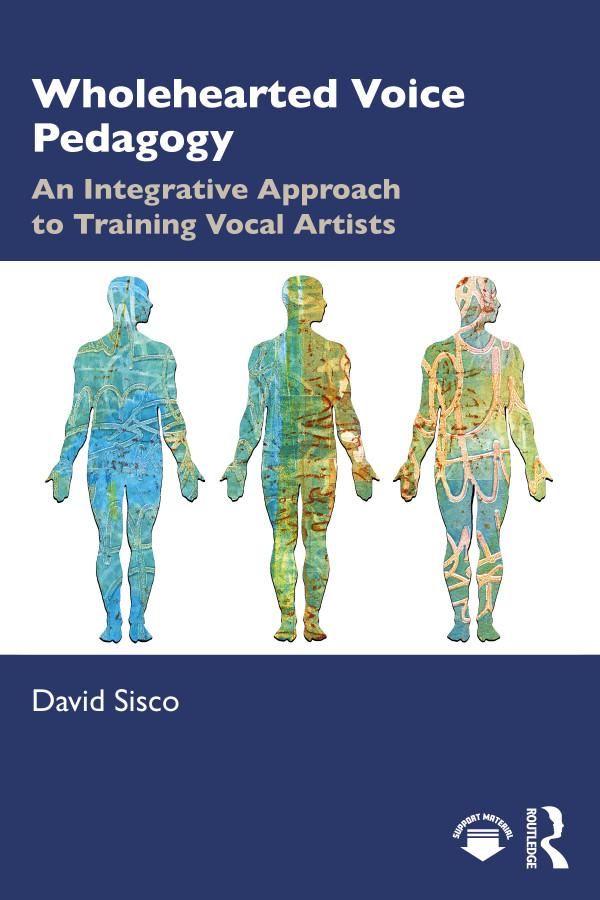
Many of the vocal pedagogy books highlighted in this column share common characteristics, such as detailed discussions of respiration, diagrams of laryngeal anatomy, and applications of acoustic knowledge. Author and voice teacher David Sisco focuses on an entirely different—though no less crucial—element of pedagogy in his new book, Wholehearted Voice Pedagogy: An Integrative Approach to Training Vocal Artists (Routledge, 2025).
In Part 1, Sisco focuses on the interpersonal relationship between student and teacher. He offers pillars for holistic teaching and guidelines for clear communication with students, including how to navigate conflict and set healthy boundaries. In Part 2, he examines how to develop artistry, with particular focus on helping students “access their own humanity.” The section also includes guides for collaborative repertoire selection, development of effective practice skills, and tools for objective assessment of student progress.
The author outlines his ideas for a “wholehearted approach” to voice teaching in the interview below.
You identify right away in the preface that voice teachers must continually cultivate an understanding of voice science and bring evidence-based research into the studio. Then you state, “Our ability to manage relationships and clearly communicate with students—which is also evidence based—is just as important as our knowledge of the voice.” Why did you decide to make this the focus of your book? What sparked your interest in the subject?
A few personal vignettes en route to answering this question:
In graduate school, more than one voice faculty member suggested I wouldn’t have a significant career in opera. What I received, however, was that my voice wasn’t worthy of being heard at all. I internalized that message so deeply that I developed debilitating sinus infections anytime I sang publicly. It took me over 15 years to heal from that internalized narrative.
Early in my teaching career, an exasperated colleague asked, “What are you doing with your students? They’re progressing so quickly!” I replied, “They just keep showing up and doing the work.” At that time, I didn’t know exactly what I was doing—aside from trying to ensure they felt safe and had solid technical tools.
More recently, I interviewed for a faculty position at a top musical theatre program. The final prompt was Name your clients, and tell us how you made them successful. I tried to answer philosophically, but was pointedly redirected. Afterward, I withdrew from consideration.
My academic and vocational journeys continue to remind me that words matter—especially in one-on-one student-teacher relationships. Investing in voice science is a noble (and necessary) pursuit—but if we don’t also invest in how we communicate, set boundaries, and cultivate trust with our students, we risk creating harm that can last for years.
This book is my attempt to offer a well researched resource that invites voice teachers to reflect on how they relate to students—not just what they teach them. Because, as Relational-Cultural Theory illustrates, the relationships we develop with students are just as impactful to student growth as the information we share.
Some readers may think of terms like “evidence based” as applying only to science-oriented elements of voice pedagogy, like anatomy, physiology, and acoustics. Can you explain how practices related to managing relationships and communicating with students can also be evidence based?
I agree that, to date, the terms “evidence based” and “science informed” have mainly been associated with what William Earl Jones calls the “‘harder’ sciences of physiology and acoustics.” My aim in applying these terms to research fields like cognitive science, education, mindfulness, and sports psychology is to encourage our community to equally value this evolving knowledge within the voice studio.
For example: how might we use what Australian researchers Elizabeth Molloy and Margaret Bearman describe as “intellectual candour” to foster a safe environment where students feel comfortable to do the vulnerable work of singing? How can we use motivational interviewing to help us move past frustration with students who seem stalled in their vocal progress? What role does the autonomic nervous system play in singing? How might insights regarding motor skill learning influence the way we guide students’ practice? And how do we navigate conflict—an inevitable part of human relationships—that can be especially damaging in the student-teacher dynamic?
Interestingly, the concept of evidence-based practice was pioneered by Florence Nightingale during the Crimean War in the 1800s. Her idea was simple: collect and analyze data to improve patient care. If our goal is to create a student-centered, trauma-informed, and culturally responsive learning environment, we must expand our island of knowledge to include these broader, interdisciplinary fields.
Some teachers may feel that giving students too much autonomy in voice lessons could lead to chaos, sacrificing structure and hard-earned teacher expertise in favor of simply bending to the whims of what students may be feeling on any given day. How would you respond to such comments?
I understand those who voice this concern, but believe it incorrectly suggests teachers have full control to begin with. Joseph McDonald writes that real teaching “happens inside a wild triangle of relations—among teacher, students, subject—and the points of this triangle shift continuously… Inside the triangle, clear evidence is very rare.” I’ve similarly found teaching to be a kind of improv, one that demands a willingness to translate only the knowledge which is necessary to the student at that moment. While we may have access to hard-earned expertise about the voice, each student is also an expert—on themselves.
This does not mean, however, that we give students carte blanche in the studio. That creates just as unsafe an environment as dictating every moment of a lesson. We are called to collaborate with students, co-creating learning environments and developing healthy, flexible boundaries. Some students will need more guidance than others. It’s our job to continually assess each student’s needs and adjust our approach accordingly. As Gloria Brown Wright notes in her article, “Student-Centered Learning in Higher Education,” teachers are most impactful when they migrate from “sage on the stage” to “guide on the side.”
On a functional level, if we’re always in the driver’s seat, we are more likely to teach the same lesson over and over. I made this mistake as an early career teacher and—my God—was it mind-numbing! Taking a more student-centered approach ensures that each lesson will be different because we’re allowing the student to enter into the work from their starting point, not ours. As I explore in the book, research has shown that this yields more positive student results and buoys teacher well-being.
REVIEW
Author and pedagogue David Sisco wastes no time getting to the heart of his philosophies in Wholehearted Voice Pedagogy: An Integrative Approach to Training Vocal Artists. Right away in the preface, he offers a definition for “wholeheartedness,” which he believes can positively impact students in the voice studio in a variety of ways. Borrowing language from author and researcher Brené Brown, wholeheartedness involves engaging in our lives from a place of worthiness, embracing tenderness and vulnerability, claiming power, and embodying the ideas of “I am enough” and “I am worthy of love and belonging.”
Sisco notes the struggles he has observed in young vocal artists as they work to overcome mental and emotional hurdles in their singing. He feels these issues go hand in hand with their efforts to develop a healthy, sustainable tone. Therefore, a voice teacher’s “calling” is to continue pursuing an understanding of voice science (by attending conferences and workshops, reading the latest research, and exploring their own vocal artistry) while also considering how it is that this information is communicated to students. As Sisco writes, “Our depth of knowledge is only as effective as our commitment and ability to help students access it through the varied lenses of their lived experiences.”
In Wholehearted Voice Pedagogy, Sisco goes beyond how the voice works and what skills singers should develop to explore why we teach and, ultimately, why a student would choose to learn more about singing. He encourages greater partnerships between teachers and students as both bring the best of themselves into the voice studio. He again paraphrases Brené Brown by stating, “What you know is important, but who you are is more important.” A wholehearted approach, therefore, creates safer spaces of learning, where “students can try, fail, question, and soar.”
Many of the processes Sisco lays out for teachers may feel intuitive, like remaining curious, embracing vulnerability, and following student-centered and equity-centered practices. Given the traditional nature of voice teaching, however, where we often teach in the way they were taught (Sisco provides a detailed analysis and reexamination of the “master-apprentice model”), it can take effort and intentionality to entertain new ideas and to honestly assess historical practices that may not be serving voice students as well as they could.
Sisco guides readers through this process, providing thoughtful yet practical tools for teachers of all levels of experience. Notably, Sisco’s writing is equally wholehearted as he gently encourages readers to mindfully reflect on their teaching philosophies and practices. Wholehearted Voice Pedagogy is an important and necessary resource, exploring a branch of vocal pedagogy that has heretofore not been given its proper due.
