The Singer’s Library: Vocal Traditions and Exposing the Chasms in Voice Pedagogy

One new book published by Routledge explores valued vocal traditions, and the other makes the case for change.
The Voice and Speech Trainers Association (VASTA) is a global, non-profit organization serving those who work in the voice and speech profession. This includes, but is not limited to, those who provide voice training for stage actors. VASTA offers a multitude of educational opportunities that explore the art and science of the human voice. The organization is particularly well known for hosting an annual conference and sponsoring a flagship journal, The Voice and Speech Review (VSR).
An ongoing collaboration between VASTA and academic publisher Routledge has resulted in a book titled Vocal Traditions: Training in the Performing Arts. The volume presents a series of essays describing the primary tenets of many of the pedagogies, methodologies, and schools of thought related to how to teach voice and speech production. This includes popular practices—like the Linklater Voice Method, Fitzmaurice Voicework, and Lessac Kinesensics—alongside methods that may be lesser known to audiences in the United States, like Breathwork Africa. It covers methods that include singing as part of the training—like Estill Voice Training and Somatic Voicework™ The LoVetri Method—and methods like the Vocal Combat Technique that train performers to produce “vocal extremes,” like screams, growls, grunts, and creature voices, “in the healthiest way possible.”
The project was spearheaded and edited by Rockford Sansom, a professor, theater voice coach, and former Editor of the Voice and Speech Review. All of the chapters were previously published as articles in the VSR between 2017 and 2022, which Sansom then selected for the book. As he describes, “I orchestrated the series of articles that I always wanted to read,” acknowledging that his undergraduate studies focused on a singular voice method, which left him lacking when it came to knowledge of the wider field. Therefore, the book “unapologetically” invites readers to compare each of these vocal teaching theories. “This series hopefully sparks curiosity about other pedagogies and pollinates vocal communities,” Sansom says. “My hope is that voice trainers will read about other kinds of teaching and seek it out, going beyond what they have studied and what they currently teach.”
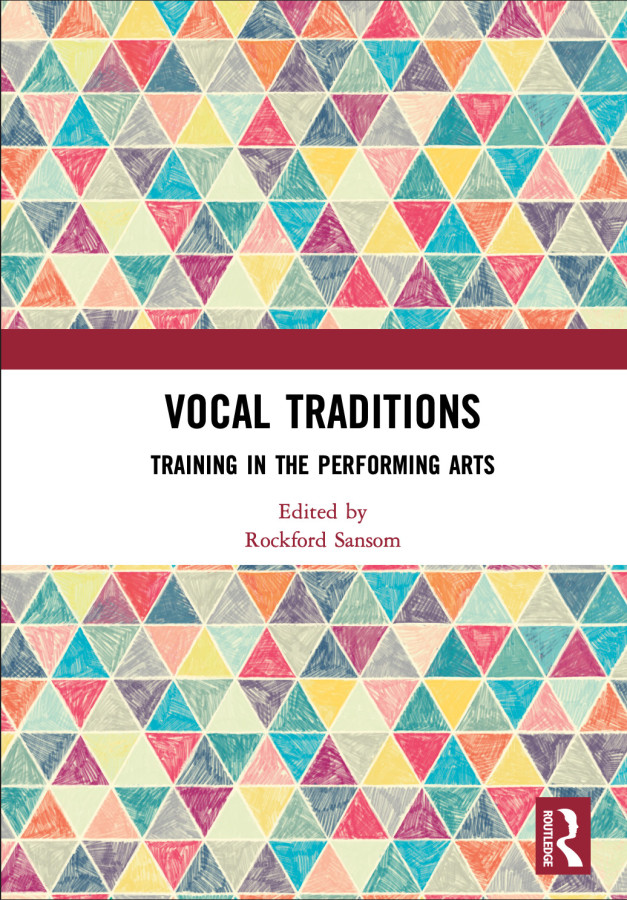
For singers and singing teachers who earned music degrees, there is often a lack of understanding about the parallel voice training that occurs in theatre programs. Although names like Uta Hagen, Sanford Meisner, and Cicely Berry may be familiar, many of us would be hard-pressed to articulate the practices that each espoused or how their approaches compare to others. In this sense, Vocal Traditions: Training in the Performing Arts is a uniquely valuable resource. Its side-by-side summaries of multiple methods, provided by notable practitioners, offer a useful guide for all those interested in voice training.
Voice teacher, researcher, and performer Dale Cox presents fascinating findings and perspectives in her book Exposing the Chasms in Voice Pedagogy: Playing the Field (Routledge, 2024). Cox created a research project to investigate how musical theatre voice teachers teach singing and to better understand how the relationship between the backgrounds and training of these teachers impacts their practice. Her qualitative research involved voice lesson observations and interviews with teachers at a series of university programs in the United States.
The details and parameters of the study are thoroughly outlined in the book. In her conclusions and reflections, Cox reveals that some programs are structured in such a way that may limit students who are pursuing contemporary commercial music (CCM) styles, like musical theatre. One key discovery was just how much classical technique and repertoire are taught in these programs. As Cox states, “I questioned why this classical content was so present in music theatre degrees. Shouldn’t music theatre students receive the same level of expert, focused training on the repertoire they will be required to perform as professionals in musical theatre as classical students receive in their degrees?” This classical focus occurred at all of the institutions where she conducted her observations, which appeared to be at the expense of time spent working on CCM-specific repertoire and technique. “I believe that as educators we should be training students adequately for the profession they wish to enter,” Cox says, “whatever that is.”
Part of why this may be the case, as her research highlights, is that many voice teachers in academic institutions received the bulk of their own voice training and have the majority of their performance experience in the classical realm. This can create systemic problems when the students who pass through these programs become teachers themselves, possibly bringing with them a “classical voice default” as a perceived necessary foundation for other styles of singing. “The dissonance between the background and training of musical theatre voice teachers and the requirements of their practice, if not actively addressed, continues the cycle, reproducing the same voice problems in newly graduated students,” Cox says. This problem is exacerbated when considering the dearth of graduate programs in CCM voice pedagogy when compared to those whose primary focus is classical music and technique.
Cox acknowledges that including CCM in academic programs as an equal and valid discipline in its own right could overturn the idea that classical singing belongs at the top of the voice pedagogy hierarchy, which some teachers may perceive as threatening. Of course, as Cox points out, neither classical nor CCM needs to be viewed as innately superior. “This does not need to be an oppositional paradigm,” she says, “and I am not interested in rehashing the contemporary versus classical culture wars. However, including CCM as a field in music performance education at the undergraduate level in more music departments in the United States is a way to increase music performance education participation in light of falling enrollments in classical music programmes.” As she astutely notes, “A contemporary music performance department sitting alongside a classical department could provide the additional expert training future voice pedagogy students require, as well as providing the appropriate education for those performers interested in CCM or music theatre singing.”
Exposing the Chasms in Voice Pedagogy covers topics that have wide-ranging implications for those in the profession. In particular, it should be required reading for all voice teachers working within academia. Cox pulls back the curtain on institutional biases that prevent degree programs from preparing students for the realities of the industry. Programs unwilling to address these biases and adjust as cultural tastes and opportunities shift risk contributing to their own extinction.
