(Re)introducing: The State Opera of New Jersey
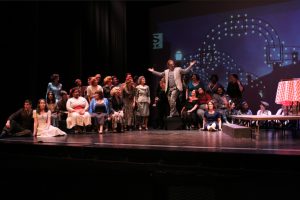
The New Jersey opera scene’s “best kept secret” gets a new name for an exciting new era.
Mercer County, NJ, home to the state capitol of Trenton, and roughly 60 miles outside New York City, is a flourishing artistic community deeply rooted in Italian culture and music. A flurry of theater companies, music societies, community choruses, orchestras and, yes, opera companies, were all born there in the last three decades of the 20th century.
Veteran music educator and conductor Joseph Pucciatti—along with his wife, concert pianist, opera lecturer, and teacher Sandra Milstein-Pucciatti—are longtime residents and participants of Mercer County and its culture. “It was a very tight-knit musical society,” Pucciatti says. “But in those days, it was very tough to get into. So, we were rebels and just started our own club.” The couple named their “rebel” opera club “The Bohème Club” after Puccini’s own Club la Bohème, a group of friends and cohorts who gathered from 1894–1896 at the lakeside shack where Puccini was working on his famous opera of the same name.
The Bohème Club of Trenton, New Jersey, in 1981 started with performances in concert series, outdoor festivals, and dinner opera. It evolved over 36 years to become Bohème Opera, a fully incorporated opera company with the Pucciattis as co-artistic directors, staffed with its own musical and production teams, and a full, contracted orchestra and chorus director, presenting multiple, fully staged operas per year. Now in its 37th season, Bohème Opera is getting a facelift to usher it into its next era, complete with a new name: The State Opera of New Jersey (TSONJ).
“We think it’s time to let people know that we’re New Jersey’s oldest and largest opera company,” Pucciatti says. “New York has the Metropolitan, but New Jersey does not have a frontline company. But we come very close to that.” In fact, of the handful of opera organizations in New Jersey, TSONJ is the only one with its own full-time musical and production staff and regular, contracted orchestra. “There’s extraordinary style on the whole team,” says mezzo-soprano Alison Bolshoi. “When a singer comes to work in this company,” she says, “they are getting an ‘A-house’ experience in that everything backstage is professional. It just really blew my mind that many people don’t even know that this company is here!”
Bolshoi is a celebrated singer and voice teacher in the New York metro area and has performed numerous roles with TSONJ, including the Witch in Hansel and Gretel, the title role in Carmen, Amneris in Aida, and Azucena in Il Trovatore. In 2019, she committed to taking on a permanent, administrative role with the company and has since been named the incoming artistic director of TSONJ once the Pucciattis retire from formal leadership.
The original Bohème Club had quickly established itself as a popular local attraction, particularly at the Mercer County Italian-American Festival. “We would get audiences of up to 900 people coming to see us,” he says. They moved their productions into Trenton’s Central High School and eventually incorporated as a fully fledged opera company in 1989. It was during this time that the young Metropolitan Opera baritone star Vernon Hartman became involved with the company and its progressive success. “He told us we should get out of the high school and move to the War Memorial’s (1700-seat) Patriots Theater,” and it became their home for the next several years. Bohème Opera eventually settled at the 830-seat Kendall Theater at the College of New Jersey’s Center for the Arts. And their attraction to young, up-and-coming singers has continued ever since.
“We have a rich history of providing singers with opportunities to try out their roles first and then go on to a place like the Met,” Pucciati says. As with Hartman, TSONJ has cultivated and thrived on connections with both established and young professional opera stars. Allan Glassman, Mark Delavan, and Susanne Burgess all sang lead roles with TSONJ before going on to the Met. Bolshoi says, “I sang here and then went on to sing at Dallas Opera and Carnegie Hall. So, a lot of people are finding their start here.”
TSONJ is committed to hearing auditions from both managed and unmanaged singers each year. They also regularly include some local, exceptional high school singers in the chorus, where they can learn first hand from the professionals in the lead roles. “We encourage fostering a sort of mentoring relationship,” Pucciatti says, “where our principal singers will gladly talk to the younger ones, so they can really learn a lot from them.”
Bolshoi says the company’s vision also includes establishing a formally organized young artist program to carry on Pucciatti’s vision of providing young singers with the opportunity to not just cover the roles in rehearsals, but the experience to perform an entire show of their own. For their recent production of Il trovatore, cover artists sang the first rehearsal with orchestra. “Rather than just learning [their] first role with a recording,” Bolshoi says, “the idea is that we are giving young, unmanaged singers real opportunities.”
As Bohème Opera, they were known and celebrated for productions of the “war horse” operas, producing traditional, large-scale productions of favorites including Il trovatore, Turandot, Aida, Carmen, The Magic Flute, and many others. Moving into the future, TSONJ is adding to their repertory and crossing genres doing so—such as with last season’s hugely successful “Viva la Zarzuela!” concert and this year’s musical theatre season opener “SMASH! Opera and Broadway’s Greatest Hits,” as well as this November’s “Seasons of Love,” a musical theatre pastiche with musical direction by Broadway’s Andrew Wheeler and featuring four of Broadway’s rising star singers.
Then, TSONJ’s debut season will continue with a new, modern production of Die Fledermaus in English, featuring John Easterling (of Phantom of the Opera fame) as Eisenstein. As it stands, their productions are anything but boring—since 2012 they have regularly been using virtual sets, with vibrant, astounding set projections by designer J. Matthew Root. “Can you imagine,” Milstein-Pucciatti says, “the opening scene in Magic Flute with a giant serpent creeping and crawling toward you, and at the end jumping right in your face?” Or, Pucciatti recalls, “…real birds flying across the stage in Aida…. I had to remember, ‘Oh wait, I have to conduct here!’” And of the “real fire” in Azucena’s act two aria in Il trovatore, Bolshoi says: “You could hear the audience gasp!”
While TSONJ is committed to their performances on the Kendall Theater stage and community performances at various restaurants, nursing homes, and other venues in Mercer County, they also want to tour, bringing their innovative productions to communities all over New Jersey. They see outreach as a way to contribute to encouraging arts education in a country where it is only increasingly cut. “If we do more outreach with young people and they start asking for it in their schools,” Bolshoi says, “maybe the schools administrations will start putting the money back that they once gave to kids’ arts education.”
Continuing that mission into higher education institutions, Pucciatti says, “We’d also like to approach university and college theaters, which would also be an educational or performance experience for those students too.” Milstein-Pucciatti agrees, “We’re known for bringing young singers in when they’re ready for the stage, but there are so many wonderful young singers who, for whatever reasons, don’t get exposure or chances to perform.”
In its new era, TSONJ has also invested in a more robust, active presence on social media and has also been working with several marketing experts to increase awareness of the company. “There is no reason that this company couldn’t be known like Dallas Opera or others,” Bolshoi says. “There are a lot of people into the arts in New Jersey, and when we get the word out that we’re here and not going anywhere, hopefully more people will get on board and see that we need a big company like this in New Jersey. And we’re here! A professionally cast, fully orchestrated, fully set and costumed, as well as community-centered, grand opera company.”
One that, all performers and staff agree, is simultaneously and uniquely, a highly professional program for established artists, as well as a nurturing, mentoring program for young ones.
“The plans are ambitious and exciting,” Pucciatti says, “and maybe it will happen the way we see it and maybe it won’t. But you watch something grow, and you just let it grow. And we’d like the people who are excited by that to join us!”
For more information on the State Opera of New Jersey’s new season and how to get involved, please visit https://www.bohemeopera.org.
